October 12, 2026
The Lee Rayburn Show
Summary:
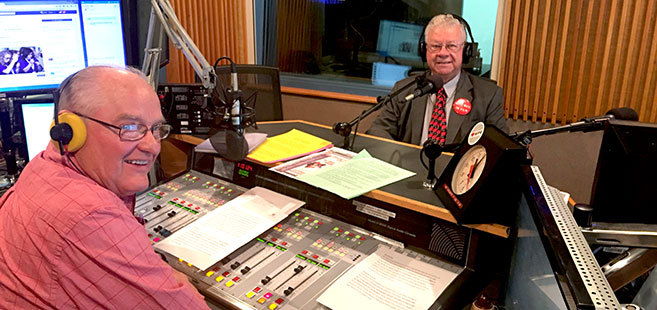
In this WPR News segment host Lee Rayburn interviews Dr. Bassam Shakhashiri, Emeritus Professor of Chemistry at UW-Madison, to highlight the upcoming 16th annual Wisconsin Science Festival and discuss recent scientific achievements. They celebrate UW-Madison physics professor Francis Halzen winning the Nobel Prize in Physics for his groundbreaking work with the IceCube Neutrino Observatory at the South Pole, emphasizing how curiosity-driven basic research lays the essential groundwork for future technological innovations and societal progress. Amid concerns over potential federal budget cuts to organizations like the National Science Foundation, Shakhashiri advocates for sustained public and government support of scientific research and education, while encouraging active civic engagement and participation in the festival’s statewide, multi-generational events.
Full Transcript
Links of interest:
IceCube Neutrino Observatory Webpage
Wisconsin Science Festival Webpage
The Chemistry of Autumn Colors
Grantmaking at NSF
|
Listen
to this broadcast
|
June 2, 2026
The Larry Meiller Show
Summary:
In this June 2, 2026 episode of The Larry Meiller Show on WPR News, host Larry Meiller interviews emeritus chemistry professor Bassam Shakhashiri about the importance of science literacy and education.
Shakhashiri defines science literacy as an active attitude requiring public engagement and respect, highlighting his work with the Wisconsin Initiative for Science Literacy to encourage the joy of learning. The discussion touches on the current science job market, the impact of artificial intelligence, and strategies for getting children interested in science by connecting it to their personal hobbies, like sports. Additionally, Shakhashiri explains the geopolitical and agricultural consequences of global sulfuric acid supply disruptions stemming from the U.S. war in Iran. The broadcast concludes with a preview of UW-Madison hosting the upcoming Biennial Conference on Chemical Education, listeners sharing optimistic perspectives on aerospace opportunities for youth, and Shakhashiri thanking Meiller during their final on-air appearance together before Meiller's retirement at the end of June.
Full Transcript
Links of interest:
The war in Iran is disrupting the supply of sulfuric acid, the world’s most common chemical
(Chemical & Engineering News)
2006 Biennial Conference on Chemical Education
UW–Madison to host largest gathering of chemistry educators in the world (UW Chemistry News)
BCCE Symposia:
Sunday, July 26: Looking Around, LOOKING AHEAD with Bassam Shakhashiri
Wednesday, July 29 - Thursday, July 30: The Art, Practice, and Joy of Engaging and Educating the Public through Scientific Demonstrations: Celebrating the Legacy of Bassam Z. Shakhashiri
|
Listen
to this broadcast
|
April 27, 2026
The Larry Meiller Show
Summary:
Prof. Shakhashiri discusses the critical role of science and education in modern society, expressing significant concern over proposed federal budget cuts to key agencies like the National Science Foundation and the National Institutes of Health. Reflecting on Earth Day, Shakhashiri advocates for environmental stewardship and emphasizes that scientific research—driven by both curiosity and innovation—is essential for societal progress. He stresses the necessity of maintaining respectful civil discourse and full participation in democratic institutions, urging citizens to vote and scientists to improve their communication with the public to bridge the gap between complex research and everyday life.
Full Transcript
Links of interest:
Where U.S. science has been hit hardest after Trump’s first year (The Washington Post)
Trump’s 2027 budget proposes deep cuts to science programs (Chemical & Engineering News)
|
Listen
to this broadcast
|
Septmeber 29, 2025
The Larry Meiller Show
Links of interest:
Mission of the Wisconsin Initiative for Science Literacy
The Science of Sound
Climate Change Graphics:
Wisconsin Plant Hardiness Zones and
Lake Mendota Ice On/Off Dates
The Structure of Scientific Revolutions
by Thomas S. Kuhn
2025 Wisconsin Science Festival
A Private Universe
|
Listen
to this broadcast
|
June 17, 2025
The Larry Meiller Show
Links of interest:
American Trilogy: The Declaration of Independence,
The Constitution, The Bill of Rights
(click to enlarge)
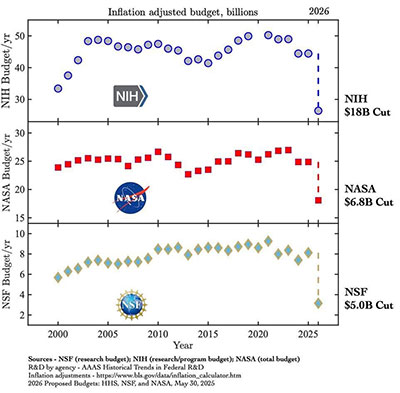
Bassam urges all concerned about the severe budget cuts to federal science research, education, the Corporation for Public Broadcasting, the arts, and the humanities to contact their elected representatives in Washington, D.C. immediately.
Trump is undermining U.S. science. Here’s why that’s dangerous. (The Washington Post)
Time for Congress to save American science…
and the nation (Bulletin of the Atomic Scientists)
|
Listen
to this broadcast
|
September 30, 2024
The Larry Meiller Show
Links of interest:
The Chemistry of Autumn Colors
Wisconsin Science Festival
Celebrating the Joy of Science and the Arts With Bassam Shakhashiri & Friends
Climate Science Concepts Fit Your Classroom:
A Workbook for Teachers and Faculty
Personal & Community Action: What can you do?
Vote for Kamala Harris to Support Science, Health and the Environment, Scientific American
Scientific American has every right to endorse a presidential candidate
Chemical & Engineering News

|
Listen
to this broadcast
|
June 10, 2024
The Larry Meiller Show
The Chemistry of Fireworks
Recommended Reading for All Ages

|
Listen
to this broadcast
|
April 1, 2024
WUWM Milwaukee's NPR
From the lab of Shakhashiri, Wisconsin scientist muses on the election, the elements and the arts
|
Listen
to this broadcast
|
February 26, 2024
The Larry Meiller Show
Jury rules for climate scientist Michael Mann
in long-running defamation case
Passion is not misconduct
A conversation with Mythbusters' Adam Savage
|
Listen
to this broadcast
|
October 30, 2023
The Larry Meiller Show
Why many scientists are now saying climate change is an all-out ‘emergency’ (The Washington Post)
Window for Meeting Key Climate Goal Is Even Narrower Than Thought (The New York Times)
Personal and community action: What can you do
Guest Editorial: Celebrating Carl Djerassi
(Chemical & Engineering News)
|
Listen
to this broadcast
|
August 28, 2023
The Larry Meiller Show
|
Listen
to this broadcast
|
June 26, 2023
The Larry Meiller Show
About the seasons: A Private Universe
A caller asked about mathematical equations for the sun radiation striking the Earth. Here is one set of equations.
Something Was Messing With Earth’s Axis. The Answer Has to Do With Us.
|
Listen
to this broadcast
|
April 24, 2023
The Larry Meiller Show
|
Listen
to this broadcast
|
April 18, 2023
Holden Thorp on The Larry Meiller Show
Thorp is editor-in-chief of Science Magazine, and his visit to Madison was hosted by the Wisconsin Initiative for Science Literacy.
|
Listen
to this broadcast
|
February 27, 2023
The Larry Meiller Show
Further reading:
Frequently Asked Questions about ChatGPT,
from Andrew Maynard at Arizona State University
|
Listen
to this broadcast
|
October 31, 2022
The Larry Meiller Show
Topics discussed included:
Climate Change: Personal and Community Action
Climate Change Graphics:
Wisconsin Plant Hardiness Zones and
Lake Mendota Ice On/Off Dates
The Chemistry of Autumn Colors
Test scores show how COVID set kids back
across the U.S. (pbs.org)
|
Listen
to this broadcast |
August 29, 2022
The Larry Meiller Show
Topics discussed included:
Per- and polyfluoroalkyl substances (PFAS)
Maybe PFAS aren't as sturdy as previously thought
Gene editing and ethics
|
Listen
to this broadcast |
June 27, 2022
The Larry Meiller Show
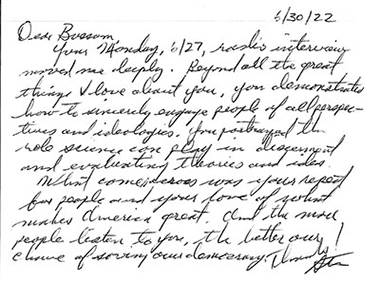
Bassam received this card from a listener after the show. (click to enlarge)
|
Listen
to this broadcast |
February 28, 2022
The Larry Meiller Show
|
Listen
to this broadcast |
November 11, 2021
Perpetual Notion Machine, WORT
|
Listen
to this broadcast |
August 31, 2021
The Larry Meiller Show
|
Listen
to this broadcast |
March 4, 2021
The Larry Meiller Show
|
Listen
to this broadcast |
October 13, 2020
The Larry Meiller Show
Read Bassam's remarks about
public confidence in science
|
Listen
to this broadcast |
June 10, 2020
The Larry Meiller Show
|
Listen
to this broadcast |
March 5, 2020
The Larry Meiller Show
|
Listen
to this broadcast |
December 10, 2019
WUWM, NPR Milwaukee
"Periodic Table of the Elements Turns 150"
|
Listen
to this broadcast |
October 29, 2019
The Larry Meiller Show
|
Listen
to this broadcast |
September 17, 2019
The Larry Meiller Show
|
Listen
to this broadcast |
August 22, 2019
The Larry Meiller Show
|
Listen
to this broadcast |
April 16, 2019
The Larry Meiller Show
|
Listen
to this broadcast |
January 28, 2019
The Larry Meiller Show
Climate is always changing—now it’s us
|
Listen
to this broadcast |
October 2, 2018
The Larry Meiller Show
|
Listen
to this broadcast |
August 27, 2018
The Larry Meiller Show
|
Listen
to this broadcast |
May 15, 2018
The Larry Meiller Show
|
Listen
to this broadcast |
October 23, 2017
The Larry Meiller Show
|
Listen
to this broadcast |
May 16, 2017
The Larry Meiller Show
|
Listen
to this broadcast |
April 18, 2017
The Kathleen Dunn Show
|
Listen
to this broadcast |