Click here for a list of upcoming and past events in the arts and humanities that relate to science literacy.
Perpetual
Motion
Revolutions in 17th-Century Science and Music
A multimedia performance that blends past, present,
and future
Dava Sobel storyteller (author of Longitude, Galileo's Daughter
and The Planets)
with Galileo's Daughters:
Sarah Pillow - soprano
Mary Anne Ballard - viola da gamba
with
Ronn McFarlane - lute
as Vincenzio Galilei
Do we fully understand oxygen, or is there more to learn about this vital and fascinating element? The Oxygen Symposium was given in March of 2003 at the University of Wisconsin - Madison. Click on the link above for an overview of the program as well as other related links.
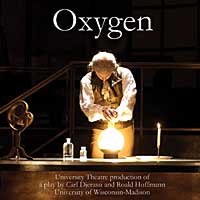 Oxygen
DVD
Oxygen
DVDThis play, written by renowned chemists Carl Djerassi of Stanford University and Nobel Laureate Roald Hoffmann of Cornell University, tells the story of a fictitious modern day Nobel panel's attempt to determine who discovered oxygen. The story is told in a series of flashbacks to the 18th century lives of Joseph Priestley, Antoine Lavoisier, and Karl Wilhelm Scheele and presents three experiments, one reflecting the work of each scientist.
This is the official, professionally recorded version from a theater production at the University of Wisconsin-Madison and includes personal interviews with the authors and director.